
Compensation Cable: Why Is Your Temperature Measurement Always "Slightly Off"?
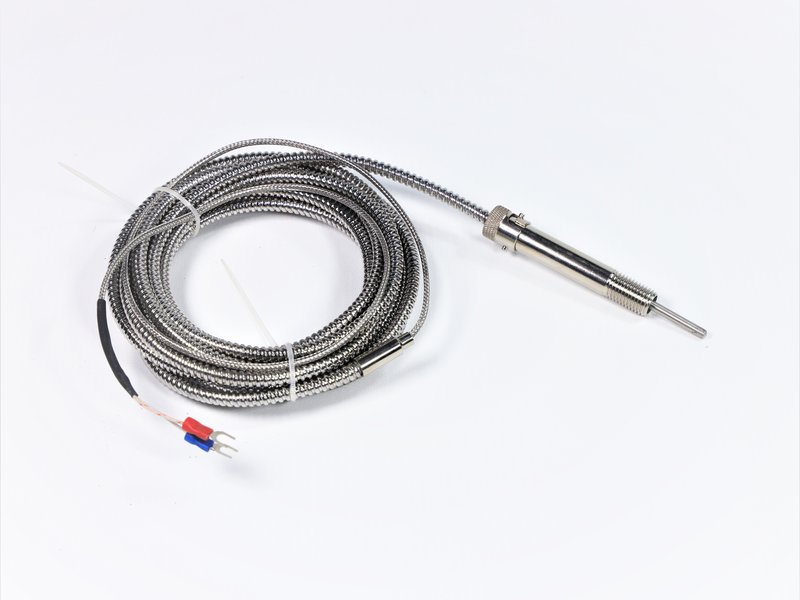
A common scenario: you replace the thermocouple, but the reading is still off; or the lance is calibrated, yet the temperature always seems "slightly" high or low. Often the problem isn't the thermocouple itself — it's the unassuming compensation cable.
What Does a Compensation Cable Do?
Thermocouples work on "two junctions at different temperatures produce EMF." But the cold junction is right there at the hot field — not at 0°C, not even constant. Pulling thermocouple wire all the way to the meter is expensive and adds error over long distances.
Compensation cable solves this: it's a pair of wires matched to the thermocouple type, with nearly identical thermoelectric properties in the 0~100°C range. Its job is to "extend" the cold junction from the hot field to the temperature-stable meter end, so the meter only needs to compensate for cold junction temperature (usually room temp).
In short: the thermocouple measures the heat; the compensation cable "transports" the signal losslessly to the meter.
Why Not Ordinary Copper Wire?
This is the most common mistake. "It's just wire, right?" Using copper instead of compensation cable can shift readings by 10~30°C.
The reason: thermocouples produce millivolt-level EMF. Copper wire paired with thermocouple wire creates parasitic EMF as temperature changes, which adds to the signal. Copper has no "type" characteristic — its thermoelectric response doesn't match the thermocouple. The higher the field temperature and fluctuation, the worse the error.
Key Points About Compensation Cable
1. Type must match: Type S thermocouple needs SC cable; Type K needs KX; Type B needs BC. Mix them and the reading is meaningless. The type is printed on the jacket — e.g. "SC-GS-VVP" means Type S, general grade, shielded, PVC jacket.
2. Polarity matters: compensation cable has positive and negative leads corresponding to the thermocouple. Reversed polarity doesn't cause a small error — it doubles or reverses the reading. This is the most common wiring mistake in the field.
3. Temperature limits: compensation cable isn't thermocouple wire — it only maintains accuracy up to 100°C (general) or 200°C (high-temp grade). If the cable runs near furnace walls, it exceeds the compensation range.
4. Routing: millivolt-level signals are easily disturbed by power cables. Use metal conduit or shielded cable with the shield grounded at one end.
Troubleshooting Field Issues
When measurement is off, check in this order:
Step 1: verify the thermocouple itself — test with a calibrator or swap in a new one.
Step 2: check cable type — does the jacket marking match the thermocouple?
Step 3: check polarity — are positive and negative leads reversed?
Step 4: check routing — is it running parallel to power cables? Is the shield grounded?
Step 5: check terminals — oxidation or loose contacts add resistance that distorts the millivolt signal.
Summary
In a temperature measurement system, the thermocouple is the "sensor," the meter is the "display," and the compensation cable is the "data line." A bad data line makes even the best sensor useless. Many "slightly off" temperature problems in the field trace back to this unassuming wire — next time the reading is wrong, check the cable first.